
Rabbi Shoshana Kaminsky’s Sermon
Comunidad Hebrea

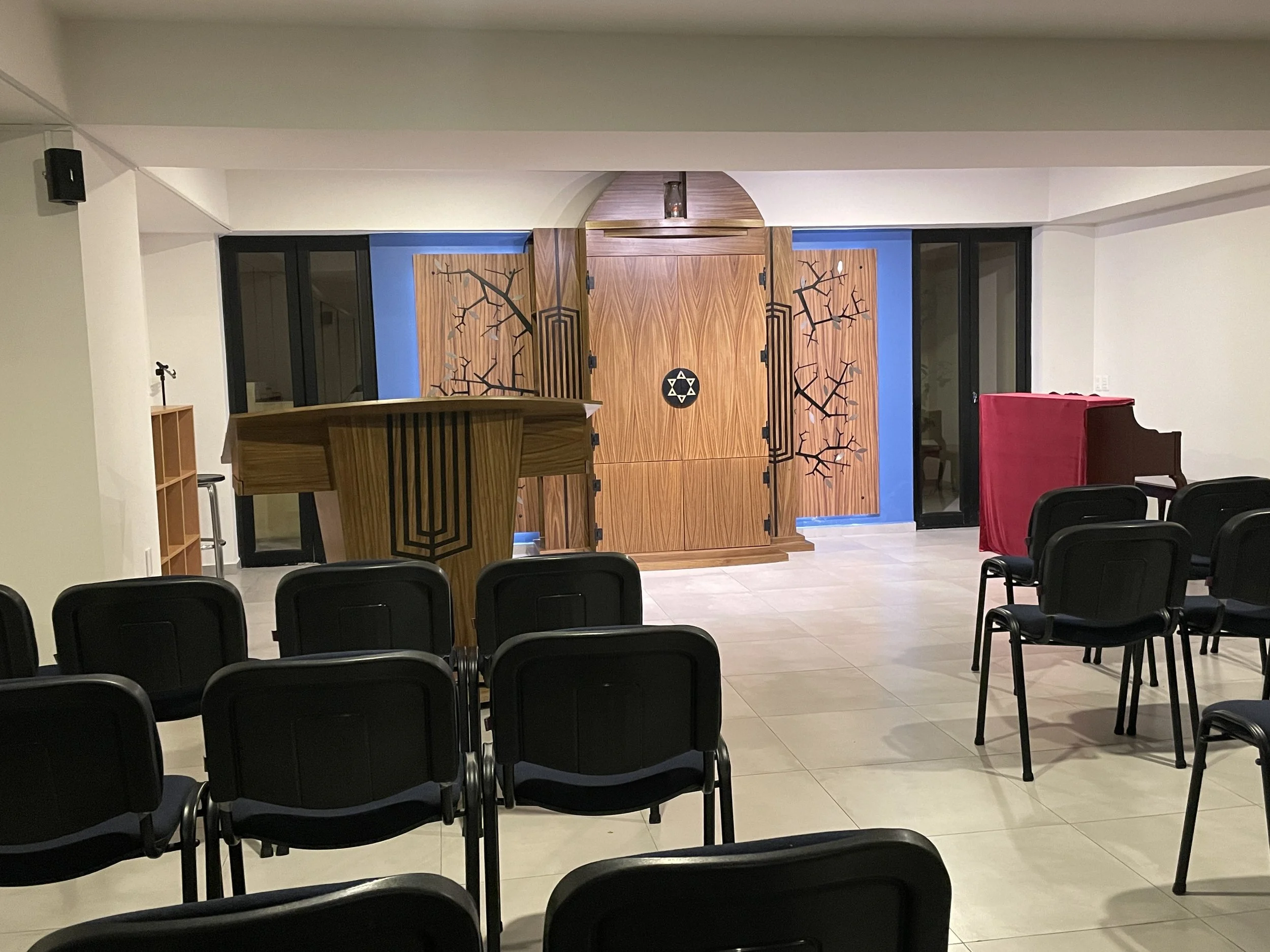
Guadalajara synangogue
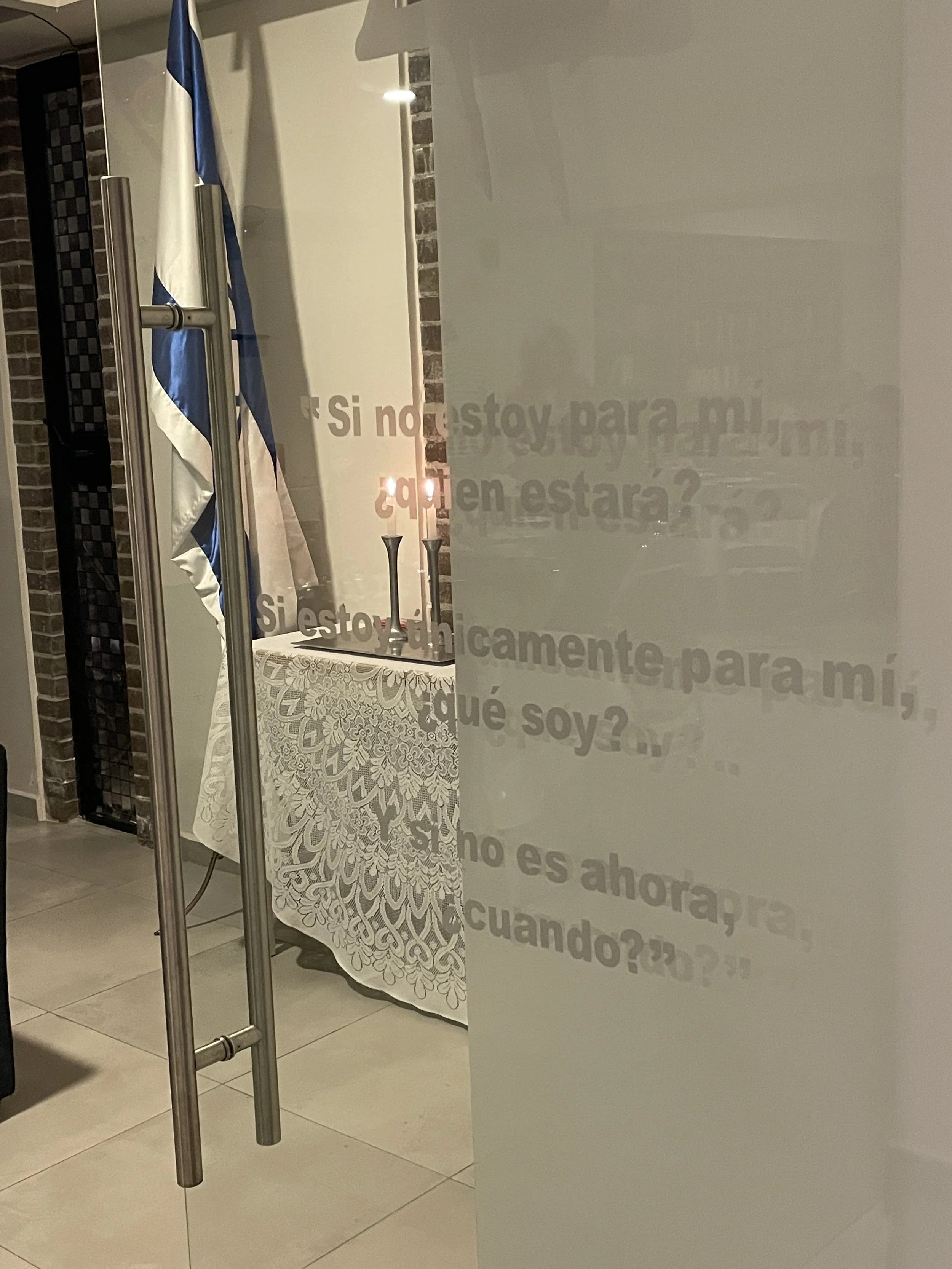
Hillel’s words
Sermon 3/21/26:
I admit to being beyond relieved that I didn’t have to give a sermon last Friday night. My partner Juan Luis and I were in Guadalajara, so I had the night off of rabbi-ing. But, as we do when we are out of town, we did go to synagogue. We went to services at the Comunidad Hebrea de Guadalajara, which is affiliated with Masorti Olami—the Conservative movement outside of the United States and Israel. Here is a photo of this humble, lay-led synagogue. And here are iconic words from the sage Hillel: If I am not for myself, who will be for me? If I am only for myself, what am I? And if not now, when? Two members of the congregation led services, with an older gentleman playing the piano with great enthusiasm. There were lots of familiar melodies along with some that were completely new. There was very little of the sermon that I understood, except that I caught that he was speaking about the ancient tabernacle as a focus of holiness in space, and Shabbat as a focus of holiness in time. In general, it was a pleasant way to welcome Shabbat.
In order to attend services, we had to complete a security questionnaire and submit scans of our passports. Only then did a member of the synagogue send us the address. We arrived at this building, absolutely devoid of anything that looked like a synagogue. There was a security guard at the parking garage, and he directed me to the central door. There was a mezuzah affixed to the door, which is kind of a secret code for a Jewish location. I rang the bell, and after answering a number of security questions, we were admitted. As you can see, there is absolutely nothing that would indicate that a Jewish congregation gathers here regularly.
Synagogues and other Jewish organizations these days can choose from two options to keep safe: they can maintain as low a profile as humanly possible, as is the case in Guadalajara and in a few other places that I’ve visited. More commonly, they can provide greater and greater layers of protection and security designed to radiate an impression of strength. We often do this with security guards and off-duty police officers. As we saw last week, that’s not always enough. Last Thursday a heavily-armed man drove a truck through the entrance of a Detroit synagogue and down the hallway towards the preschool wing. Extraordinary coordination and training by the security guards and staff meant that all 140 preschoolers were saved. The next day I received an email from a Temple member asking if it was safe to attend our services. I could only truthfully give the following answer: we do everything possible to keep ourselves safe, including drawing on the considerable expertise of professionals within the Secure Communities Network. At the same time, there is no way that we can guarantee with 100% confidence that we will be able to stay safe.
It is both sad and infuriating that this is the reality of Jewish life in 2026. I have reluctantly concluded that anti-Semitism is a hatred which is so utterly irrational that it feels almost primordial. In recent years, Jews have been blamed for capitalism, communism, the 9/11 attacks, Covid, and even for the attacks of October 7, 2023, in which 1200 Israelis were murdered and hundreds more taken as hostages. Outside of Israel, we Jews are blamed for every single decision made by the Israeli government. It’s hard to explain why protests against Israel results in attacks on Jews all around the world. And that’s because it makes no sense. I recently had a late-night conversation with someone who asked me to explain why anti-Israel protests had such a negative impact on the Jewish community, and of course I couldn’t come up with a rational way to explain it. And then, in a slip of the tongue that I’m sure only happened because of the late hour, he referred to Netanyahu as prime minister of the Jews, rather than prime minister of Israel. I immediately called his attention to his mistake, and that’s when he started to understand.
I said earlier how relieved I was that I wasn’t here last Friday night to deliver a sermon. That’s because my thoughts were in such turmoil that there was no way I could possibly offer anything coherent, much less hopeful. My journey towards this evening began with the discovery of this powerful poem by Rabbi Hanna Yerushalmi:
If I am to die
If I am to die because I am a Jew,
let me know, without hesitation,
how to be that Jew they hate so much.
Let autumn new year's greetings
from love ones linger in my ears
and hours spent in synagogues
be a part of my permanent record.
Let wearing a tallit, a star on a chain,
kissing a mezuzah, baking challah
and traveling to Israel be a normal part
of my routine, connecting me to you.
Let the fragrance of an etrog and a spice box
and the taste of pomegranates seeds
and matzah with haroset be familiar to me.
If I am to die as a Jew,
let me be blessed to have lived as Jew,
my home full of menorahs and siddurim
for my sons and daughters to inherit,
so they can hold a tangible piece of me,
and know that my life and my identity
would not become a fleeting tale.
Let me be buried as my ancestors were,
in a simple casket, with psalms chanted
and ancient words recited in a round.
And let it be known that I died in vain,
before my time, at the clenched hand of hatred.
This I cannot control, and I do not accept.
But if I am to die because I am a Jew, then
let me dedicate my life to living fully as a Jew.
@Hanna Yerushalmi
Rabbi Yerushalmi’s words touched something deep within me. I remember learning as a child about how Jews in the Middle Ages found themselves presented with an impossible choice: either convert to Christianity, or be executed. I wondered if I would have the courage to choose to die for my values as well as living by them. Either way, it’s so important for me to live the fullest Jewish life that I can, to find every opportunity for meaning and joy each and every day. For me, that means small actions like offering a blessing before I eat or drink and reciting the Sh’ma each night before I go to sleep. But, of course, it also means big things like living very publicly as a proud religious Jewish leader.
I’m not sure there are any words that can bring comfort and reassurance that are also honest and true to the dangers of this present moment. However, I believe quite sincerely that living a fully Jewish life is worth it. One place to start is with embracing Shabbat. In just a moment, I’ll light the Shabbat candles. Then I’ll circle my arms around the candles three times before I recite the blessings with my eyes closed. When I do that, I always visualize bringing the light and warmth of those candles inside me. I invite you to do the same. Each step we take through this evening’s service is an invitation to leave the craziness of the world behind and to move into a space of peace and tranquility, at least for a little while. This week, we will gather for Shabbat once again tomorrow morning. Once Shabbat is over, we can return to the work of trying to heal this broken world, which is also essential to who we are as Jews. But this time right now belongs to the inner life. May this Shabbat renew us for good, for love, and for purpose, and may our lives as Jews bring us unending joy and hope. Amen.
